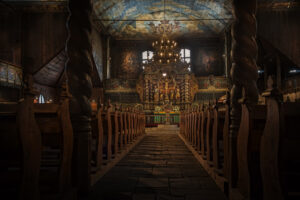
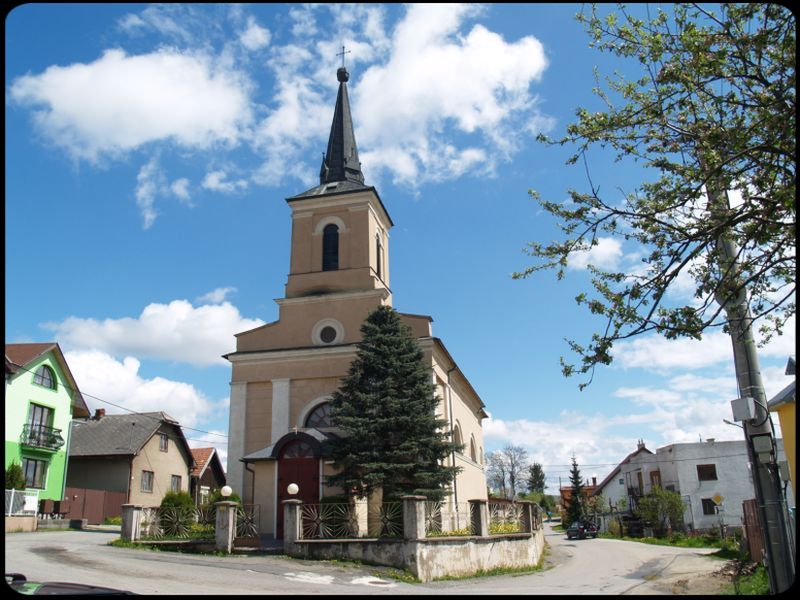
The first mentions of the church are known from 1499 and 1520. The original church was rebuilt in classical style after a fire (1832) in 1835. Later it was completely demolished and the present brick church was built in its place in 1844 - 1847, in the classical style. The former main, now side, late Baroque altar from the 2nd half of the 20th century was built in the church. 18th century. St. Michael the Archangel, the patron saint of the local church and the village, adorns the statue of St. Michael the Archangel. The church has a late Renaissance relief, the interior is curved with Prussian vaults, the façade is classically arranged with thermal windows and pilasters. On the present main altar, the statue of St. Michael is depicted in a pose, as he tramples the head of the snake - the devil - with his foot and pins it to the ground with a spear. St. Michael wears a helmet on his head and has wings spread on his back. At the top of the altar is the Holy Trinity. There are two other altars in the church. The older of them, which is located on the right side of the church, is the side altar dedicated to the Virgin Mary, with a painting from the second half of the 18th century (oil on canvas - 1783), which depicts the Madonna and Child Jesus. On the left side is the second side altar, which was made from the donations of the members of the Holy Rosary Society, by the master Švidroň from Levoča. It is the altar of the Divine Heart of Jesus, whose statue is placed on it. On the choir is installed an organ, made by Gebruder Rieger, with two inscribed years - Vienna 1873 and Paris 1878. The interior of the church is decorated with very nice wall paintings by the master painter Julius Adam (1922). There are three large paintings on the ceiling. Three bells are installed in the bell tower of the church. The largest one - St. Michael, was cast in 1924 in Trnava by master Alois Kurbel from the charity of the inhabitants of Malý Slavkov. There is an inscription on it that it rings to the glory of God. The second bell is called Mary and was also cast in 1924 in Trnava by master Alois Kurbel. The third bell is the so-called "cingalka", or "dying bell", which is not dated. Source: www.obecmalyslavkov.sk


Menu
close