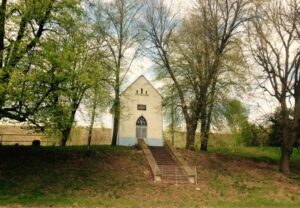
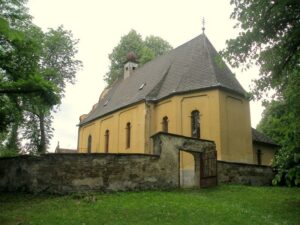
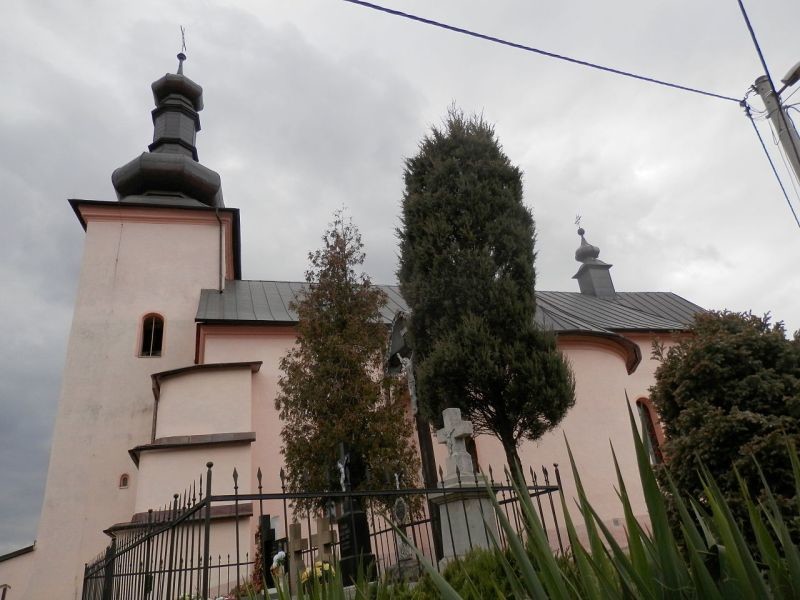
In Hermanovce it is assumed that the church was built already in the year of its foundation - in 1320. The church was probably wooden and we can almost certainly say that it stood on the site of today's church. Later it was rebuilt in stone in the late Gothic style - such is mentioned in 1438.
The church was also rebuilt later. Adapted to contemporary trends in architecture. In 1650 it was rebuilt in Baroque style. The changes were visible mainly in the interior of the church - Baroque is known for decorating the space with ornaments. The pulpit comes from that period. Side chapels were added in 1840. The two side altars come from the Augustinian monastery of Hrabkov.
The main altar and the monstrance are among the most important and the oldest Hermanov monuments. The monstrance is wrought from gold-plated silver. The box is flanked by sculptures of saints and angels. It was created in the second half of the 18th century and stylistically belongs to the Rococo artistic movement. It was created by Ján Siláši, a goldsmith from Levoča, who is also the author of the Herman chalice. The chalice is also made of gilded silver. The goldsmith created it in 1776.
Altar Hermanovsky church is composed of at least two parts that were not made together - the Gothic statues of St. Dorothy, Madonna and Barbara in the central part, the so-called altar case, and the Gothic panel paintings in the four fields on the sides. These parts are the oldest. They are said to have been brought from the Augustinian monastery of Hrabkov, which disappeared in the 1680s. The inner side of the altar wings (the visible part) depicts the motif of the Resurrection, the Nativity, the Adoration of the Three Kings and the Death of P. Mary. The compositions are on a gold ground. The wood carvings are related to the work in the workshop of Master Paul of Levoča and the paintings to the workshop in Spišská Kapitula. On the outer side of the wings (facing today behind the altar, unrestored), the saints are depicted in groups of three - Eduard, Imrich, Ludovít; Florian, Sebastian, Erasmus; Martin, Wolfgang, Juraj and Augustine, Nicholas, Lawrence. The other architecture of the altar is neo-Gothic.
Source : www.alfamedia.sk
Cover photo: Wikipedia - Jozef Kotulič - Own work, CC BY-SA 3.0, https://lnk.sk/alD9